What Is Onboard Credit (OBC)? The Complete Cruiser's Guide

Win Lin
Updated June 15, 2026
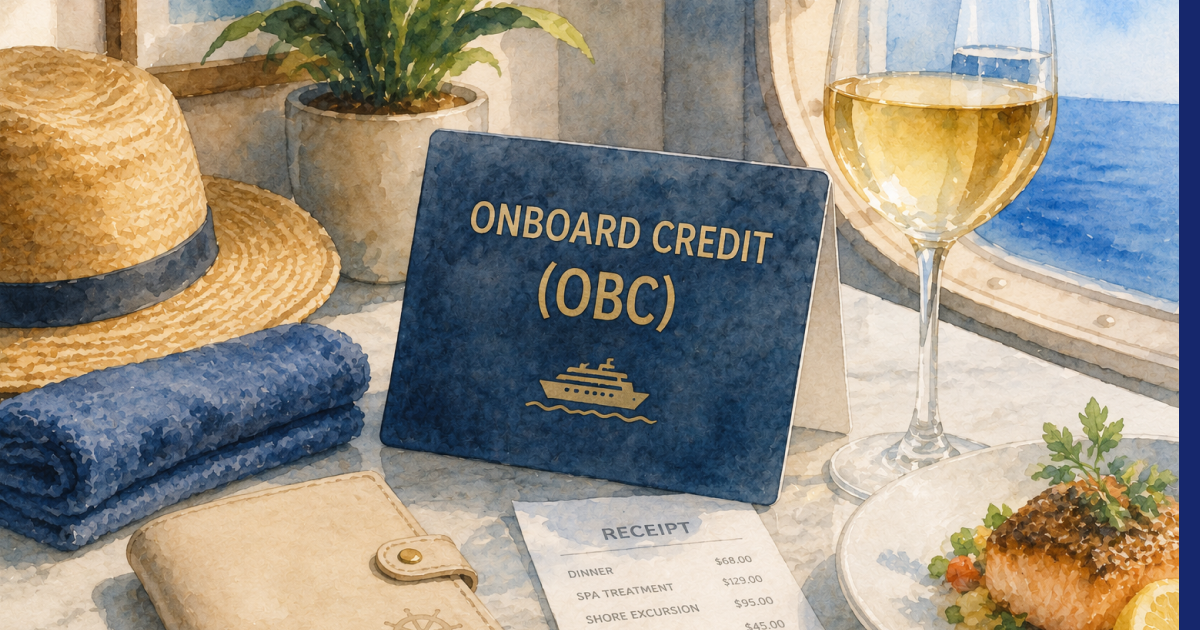
If you have spent any time researching cruises, you have probably seen three letters pop up again and again: OBC. Onboard credit is one of the most valuable, and most misunderstood, perks in cruising. It can pay for dinner at a steakhouse, a shore excursion, a spa day, or your bar tab, yet many first-time cruisers board the ship without fully understanding what their credit covers, when it expires, or whether they will ever see a refund for the part they do not spend.
This guide breaks down exactly what onboard credit is, where it comes from, what you can and cannot buy with it, how the rules differ from one cruise line to the next, and the single most important distinction every cruiser should understand: refundable versus non-refundable credit. By the end, you will know how to squeeze every dollar of value out of your OBC instead of scrambling to spend it on gift-shop trinkets on the last night.
What Is Onboard Credit (OBC)?
Onboard credit, often abbreviated as OBC and sometimes called "cruise cash" or "shipboard credit," is essentially spending money that is applied directly to your onboard account before or during your sailing. Because cruise ships run as cashless environments, nearly everything you buy is charged to the folio attached to your room key or cruise card. Onboard credit sits in that account as a balance, and as you spend money on the ship, your purchases draw down the credit first before any charges hit the payment card you have on file.
Think of it as a gift card that only works on the ship. You do not hand it to a bartender or a shop clerk; it simply reduces the bill that would otherwise be charged to your credit card at the end of the cruise. If you have $200 in onboard credit and spend $150 over the week, the line covers that $150 from your credit and you are only billed for anything above it.
Where Does Onboard Credit Come From?
Onboard credit can land in your account from many different directions. Some of it you earn, some of it is handed to you as a booking incentive, and some of it comes from sources cruisers do not even realize they qualify for. The most common sources include:
- Booking promotions: Cruise lines frequently bundle OBC into fare promotions, especially during wave season and holiday sales, to sweeten a booking.
- Travel agents: Many agencies, including online cruise sellers, pass a portion of their commission back to you as onboard credit. This is often where the largest credit comes from, and it is a major reason to book through an agent rather than directly with the line.
- Loyalty and casino programs: Repeat cruisers and players enrolled in a line's casino program regularly receive OBC offers tied to their tier or play history.
- Shareholder benefits: If you own at least 100 shares of Carnival Corporation, Royal Caribbean Group, or Norwegian Cruise Line Holdings, you can claim a shareholder onboard credit of up to $250 per voyage depending on cruise length.
- Referrals and price drops: Referring friends can earn credit, and if the price of your booked cruise falls, some lines will issue the difference as onboard credit rather than a cash refund.
- Service recovery: If something goes wrong, a maintenance issue in your cabin, a missed port, the line may compensate you with onboard credit.
All of these credits land in the same account, but, and this is the crucial part most cruisers miss, they do not all behave the same way once they are there.
Refundable vs. Non-Refundable Onboard Credit
This is the single most important thing to understand about OBC, because it determines whether unspent money comes back to you or simply disappears. Onboard credit falls into two categories, and your account can hold both at once.
Non-Refundable (Promotional) Onboard Credit
Complimentary credit, the kind that comes from booking promotions, loyalty perks, casino offers, and most bonus incentives, is almost always non-refundable. It is a use-it-or-lose-it benefit. If you do not spend it by the end of the cruise, the balance is forfeited. It has no cash value, it will not be paid out to your credit card, and it does not roll over to a future sailing. On most lines this credit expires around 10 p.m. on the final evening of the cruise, so the clock genuinely runs out.
Refundable (Purchased or Cash) Onboard Credit
Refundable credit behaves like real money. It typically comes from sources where actual cash changed hands: credit you purchased outright, a cash deposit applied to your account, an overpayment, or in some cases shareholder credit. Whatever you do not spend is returned to you, usually refunded to the card on file (or paid out at guest services) after the cruise, often within about 30 days.
Celebrity Cruises spells this out clearly: complimentary onboard credit is non-refundable, while purchased onboard credit is refundable before you leave the ship. You can read their official breakdown here.
The practical takeaway: spend your non-refundable credit first. If your account holds both types, you want to burn through the use-it-or-lose-it money during the cruise and leave the refundable balance untouched so it comes back to you as cash. Knowing which bucket each credit falls into is the difference between walking away with money in your pocket and leaving it on the table.
What Can You Use Onboard Credit For?
One of the best things about onboard credit is its flexibility. On most lines it works on nearly anything that posts to your shipboard account, which opens up a long list of options:
- Specialty dining: Cover cover charges and à la carte fees at steakhouses, sushi bars, and other reservation-only restaurants.
- Drinks and beverage packages: Apply it to individual cocktails, wine, and even full drink packages purchased onboard.
- Shore excursions: Book line-operated tours in port and let your credit absorb the cost.
- Spa and salon: Massages, facials, haircuts, and treatments are all fair game.
- Wi-Fi and internet packages: Connectivity is one of the smartest places to spend credit you would otherwise pay cash for.
- Photos: Professional photo packages and individual prints.
- Onboard shopping: Souvenirs, logo gear, jewelry, and duty-free goods in the ship's boutiques.
- Casino play: Allowed on many lines, though often with fees. More on that below.
- Laundry, fitness classes, and more: Dry cleaning, specialty fitness sessions, and other incidental services.
A Note on Gratuities
Gratuities are where cruisers get tripped up most often. You generally cannot directly "apply" onboard credit to tips in the way you would redeem a coupon. Instead, your daily auto-gratuities post to your account as a charge like any other, and your onboard credit offsets your total balance, including those gratuity charges. The effect is the same: your credit ends up covering the tips. Royal Caribbean explains this offset mechanic directly on its blog.
There is one important catch. If you pre-pay your gratuities before the cruise, those charges hit your credit card up front and never touch your onboard account, meaning your OBC cannot offset them. So if you want your credit to cover tipping, choose the standard daily auto-gratuities billed onboard rather than pre-paying.
What You Cannot Use Onboard Credit For
As flexible as OBC is, it is not unlimited. A handful of restrictions apply on almost every line, and a few lines add their own rules on top.
- Cash withdrawals: You cannot walk up to guest services and ask for your onboard credit in cash. OBC is a spending balance, not an ATM. Holland America, for example, states plainly that onboard credit cannot be used for cash withdrawals at the front desk.
- Pre-paid (pre-cruise) purchases on some lines: Promotional credit usually has to be spent once you are physically onboard. Several lines, MSC among them, according to cruisers, will not let you apply promotional OBC to things you book in advance through the planner, so you may have to wait until you board to use it.
- The casino, on some lines: While many lines allow OBC at the casino, others specifically exclude it, and shareholder or promotional credit is frequently barred from gaming even when purchased credit is allowed.
- Gratuities, on a few lines: Most lines let your credit absorb auto-gratuities, but Norwegian Cruise Line is a notable exception. It states that onboard credit cannot be applied to service charges or gratuities at all.
There is also a well-known workaround for turning non-refundable credit into something closer to cash: the casino. On lines such as Royal Caribbean, guest services will not hand you OBC as cash, but the casino will let you draw against your account as a cash advance, typically with a 5% fee, though a slot-machine cash advance can avoid that fee. It is a gray-area tactic rather than an official policy, so treat it as a last resort for credit you would otherwise forfeit.
How Onboard Credit Differs by Cruise Line
Onboard credit is a near-universal concept, but the fine print varies meaningfully from one cruise line to the next. Here is how the policies break down across the major lines.
Royal Caribbean
Royal Caribbean draws a clear line between refundable and non-refundable credit on your account, and the difference shows up in how you can cash it out. Promotional credit is use-it-or-lose-it, while refundable credit is paid back after the sailing. Royal is also the line most associated with the casino cash-advance method of converting leftover credit, and it clarifies that you do not "apply" OBC to gratuities directly. The credit simply offsets your overall balance, tips included.
Celebrity Cruises
Celebrity is one of the most transparent lines about how OBC works. It explicitly distinguishes complimentary credit (non-refundable) from purchased credit (refundable), and it publishes a clear list of ways to spend it onboard: dining, beverages, spa, shore excursions, and more. If you want a textbook example of how the two-bucket system works, Celebrity's own guidance is the cleanest.
Princess Cruises
Princess is known for one of the most generous price-protection programs in the industry. Under its long-running "best price" guarantee, if the fare on your booked cruise drops before final payment, Princess has historically issued you 120% of the difference as onboard credit, up to a cap. That makes Princess OBC something you can actively grow after booking by watching for price drops, turning a fare decrease into spending money rather than letting it go unclaimed.
Holland America
Holland America is precise about its restrictions. The line says onboard credit cannot be used for cash withdrawals, and it draws distinctions about where promotional versus non-promotional credit can go, including specific rules around casino play. Refundable credit that goes unused is returned to guests after the cruise. Holland America also runs a price-guarantee program that, like Princess, can issue the difference on a price drop as onboard credit within an enrollment window.
Carnival
Carnival's OBC rules reward planners. Through its "Early Saver" fare, any price drop you find before sailing is refunded as non-refundable onboard credit, and Carnival accepts those claims up until shortly before departure. Carnival also automatically applies leftover onboard credit toward your gratuities at the end of the cruise, so non-refundable credit rarely goes fully to waste. One quirk: specialty dining can be booked with OBC, but generally only for reservations you make once you are onboard rather than in advance.
MSC Cruises
MSC tends to be the most restrictive of the major lines when it comes to how and when you can use promotional credit. Cruisers frequently report that MSC will not let you apply promotional OBC to purchases made in advance, pushing you to spend it onboard instead. If you sail MSC, plan to use your credit during the cruise and confirm at guest services exactly what your balance covers.
Virgin Voyages
Virgin Voyages brands its onboard credit as "Sailor Loot" and folds it into a famously inclusive fare that already covers Wi-Fi, tips, and many dining venues. Because so much is included up front, Virgin's credit tends to flow toward bars, the spa, premium experiences, and shore excursions rather than the basics other lines charge for.
Disney Cruise Line
Disney issues onboard credit much like the rest of the industry, through promotions, travel agents, and shareholder benefits, and it posts to your stateroom account for use on excursions, the spa, specialty coffee, merchandise, and adult-exclusive dining. As with other lines, complimentary Disney credit is non-refundable, so it is best spent before you disembark.
How to Get the Most Out of Your Onboard Credit
Once you understand the rules, maximizing your OBC comes down to a few disciplined habits.
- Know which bucket each credit is in. Before you sail, ask your travel agent or the line whether each chunk of credit is refundable or non-refundable. This single piece of information drives every other decision.
- Spend non-refundable credit first. Burn the use-it-or-lose-it money on things you would have bought anyway, like Wi-Fi, gratuities, or a specialty dinner, and protect your refundable balance so it comes back as cash.
- Prioritize needs over souvenirs. The most common regret is blowing leftover credit on last-night gift-shop impulse buys. Put it toward connectivity, tips, and excursions first. Treat the boutique as a last resort.
- Book specialty dining early. On lines where OBC covers dining reservations made onboard, log in or visit the restaurant desk as soon as you board. Prime times disappear fast on the first day.
- Watch for price drops. On Princess, Carnival, and Holland America especially, monitoring your fare after booking can convert a price decrease into extra onboard credit. Submit the claim before the line's deadline.
- Read your booking confirmation line by line. Before final payment, confirm that every promised credit actually appears on your booking. Disputes are far harder to resolve after you have paid in full.
The Bottom Line: Onboard Credit Is Free Money, If You Use It Right
Onboard credit is one of the few perks in travel that is effectively free spending money, but it only delivers its full value when you understand the rules behind it. Know where your credit comes from, know whether it is refundable or non-refundable, spend the perishable portion first, and read your booking details before you pay. Do that, and a few hundred dollars of OBC can cover your dinners, your Wi-Fi, your tips, and a shore excursion or two, turning a nice-to-have into a meaningful chunk of your vacation budget.
This is exactly why onboard credit sits at the heart of how Zipsea books cruises. Because travel agents can pass part of their commission back to travelers as OBC, booking through Zipsea is one of the most reliable ways to walk onto the ship with credit already waiting in your account, credit you can put straight toward the experiences that make a cruise worth taking. Understanding how OBC works is the first step; getting more of it is the next.
Why Book with Zipsea
The most onboard credit on the internet
We give the absolute most onboard credit back for you to spend onboard.
Prices straight from the cruise lines
Prices and availability come directly from the cruise lines and update in real time.
Never any fees
No service charges, no booking fees — not for anything.
A team that lives and breathes cruises
Cruises are all we sell. You're always talking to someone who knows ships, cabins, and ports.
About Win Lin
CEO & Co-founder of Zipsea. Catch me in the pool, playing lawn games, or at the seafood-themed specialty restaurant. Love trying different cruises and exploring different places with friends and family.